
Jefferson County Probate Records Overview
Probate in Jefferson County is a function of the Kansas District Court. The State Court Structure Map resolves the local probate name as the Probate Division of the District Court. Jefferson County FAQ states that the Clerk of the District Court has court, probate, and divorce records. That means probate searches, filings, and certified copy requests should start with the District Court clerk rather than the elected County Clerk.
Kansas probate matters can include decedents' estates, wills, letters, inventories, accountings, creditor notices, guardianships, conservatorships, care-and-treatment proceedings, and related orders. Public access depends on the case type and document. An ordinary estate file may have many public docket entries, while adoption, care-and-treatment, and sensitive guardianship or conservatorship material may be confidential or redacted.
Probate Division of the District Court
Jefferson County District Court
300 Jefferson St.
P.O. Box 327
Oskaloosa, KS 66066
(785) 863-2461
Search Jefferson County Probate Records
The first online path is Kansas District Court CaseSearch, which is the statewide public access portal for district court case information and records when available. The research session could not inspect exact probate search fields because CaseSearch was blocked by Cloudflare, so probate users should treat the portal as a starting point, not a guarantee that every probate image or older file is online.
- Try Kansas CaseSearch for a public probate case by name, case number, county, or other available portal controls.
- If the record is missing or incomplete, use courthouse terminals or contact Jefferson County District Court.
- Use the Clerk of the District Court for certified copies, local file questions, and non-digitized probate records.
- Use Kansas Judicial Council forms and Kansas Self-Help for probate form categories and procedural starting points.
- Expect limits for adoption, care-and-treatment, sealed, redacted, or sensitive guardianship and conservatorship records.
The Kansas Self-Help probate and elder law page is one of the official statewide probate reference points.
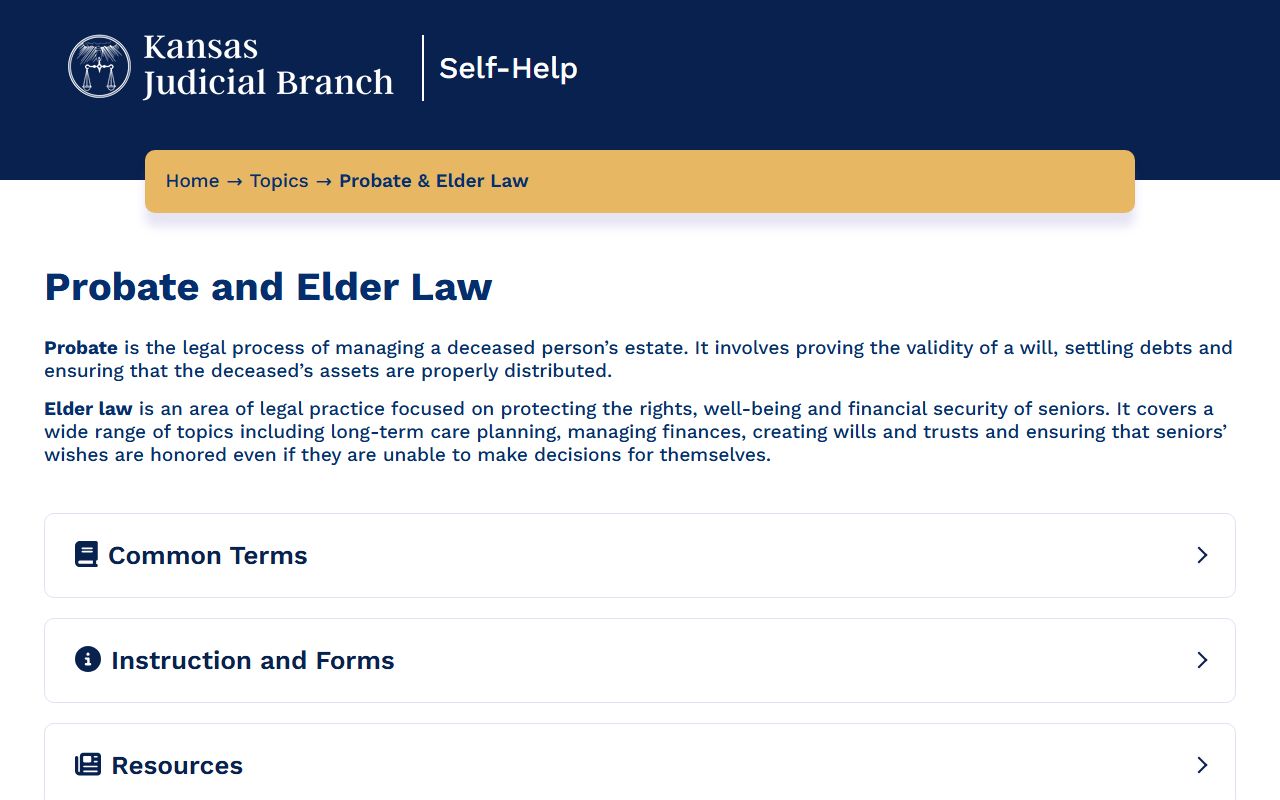
That statewide resource supports the local District Court path by pointing users toward Kansas probate forms and small estate resources.
Jefferson County Probate Terms
Probate files use terms that can be easy to confuse. A will case, estate administration, guardianship, and conservatorship may all appear in District Court, but they do not mean the same thing. The definitions below are short working meanings for reading docket entries and forms.
- Testator
- The person who made a will.
- Executor
- The person named to carry out the will and handle estate duties.
- Intestate
- Dying without a will, which may require administration under Kansas law.
- Guardianship
- Court authority over personal decisions for a minor or vulnerable adult.
- Conservatorship
- Court authority over financial or property affairs for a person needing protection.
- Letters
- Court-issued authority, such as letters testamentary or letters of administration.
What Jefferson County Probate Records Show
Probate records are built around the court case file. A file may show the case number, estate or ward caption, filing date, petition type, petitioner, attorney, judge, hearing date, notices, will filed or admitted, letters issued, inventory, creditor notice, claims, orders, final settlement, accounting, bond, fees, and sealed or confidential documents. In guardianship and conservatorship matters, the file may also include reports or information that is not fully open to the public.
The same file can serve more than one use. Heirs may need letters or orders to deal with property. Creditors may need notice and claim deadlines. A title company may need a certified order or proof of authority. Family members may need to know whether a will was admitted or whether an estate was closed. Because those needs are different, the best request names the case number if known, the document wanted, and whether a plain copy or certified copy is required.
| Field | What It Shows |
|---|---|
| Case number | The District Court identifier for the probate matter. |
| Caption | The estate, ward, protected person, or case title. |
| Petition type | The request that opened the case, such as estate, guardianship, or conservatorship. |
| Will and letters | Whether a will was filed or admitted and whether authority was issued. |
| Inventory and claims | Estate property, creditor notice, claims, and related accounting events when public. |
| Orders and hearings | Judicial action, hearing dates, and final settlement or closing entries. |
| Restrictions | Sealed, confidential, or redacted documents that may not be available in a public copy. |
Small Estate Affidavit
Kansas small estate affidavit materials are tied to K.S.A. 59-1507b. The research states that the official small estate affidavit may be used for estates under $75,000 and for certain personal property transfers without obtaining letters of administration. It may also be used in place of KDOR Form TR-83b in the circumstances described by the official materials.
The small estate affidavit can reduce the need for a formal probate case, but it is not a universal substitute for every estate. A person should identify whether the matter involves real estate, disputed heirs, creditor issues, a will that must be admitted, or property that requires court authority. If the case needs formal letters, the Probate Division of the District Court remains the local filing point.
The K.S.A. 59-1507b small estate affidavit statute is included in the probate image manifest.
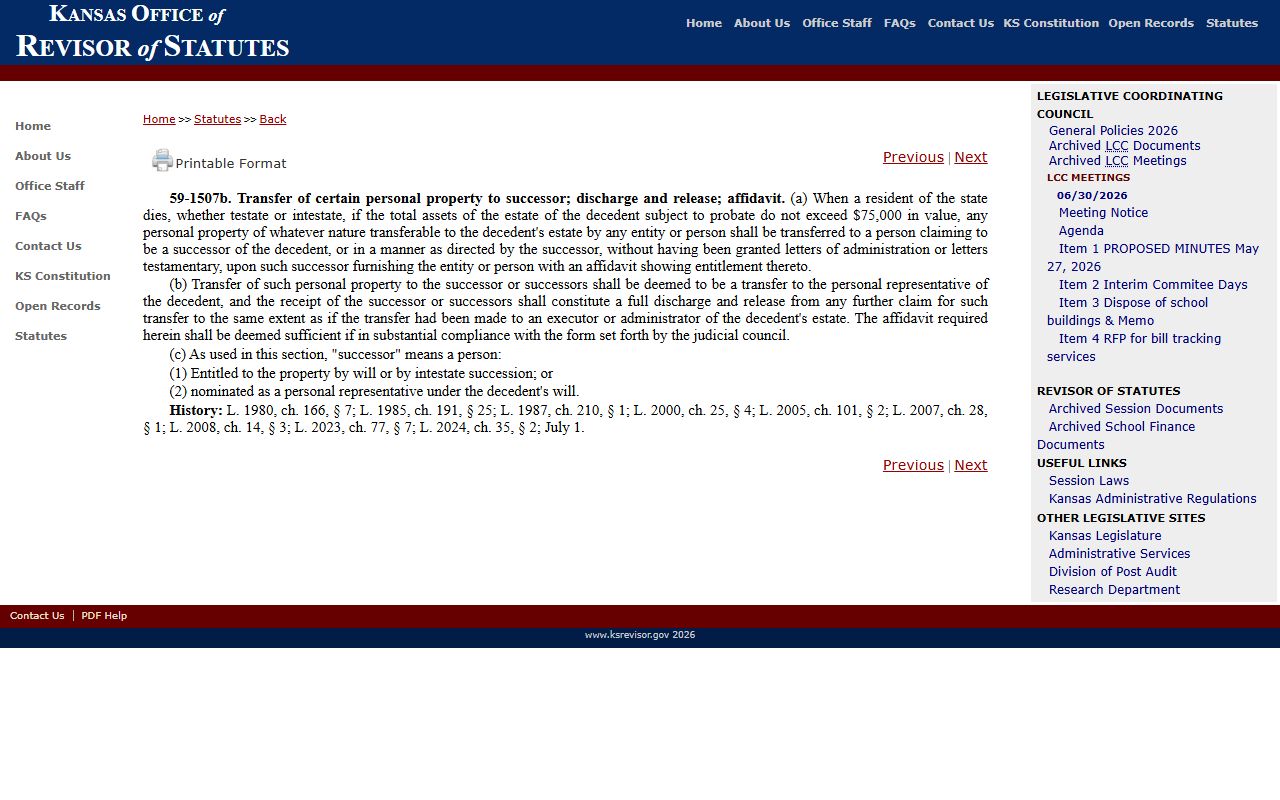
The statute should be read with the Judicial Council form because the law recognizes substantial compliance with that official form.
Probate Forms in Kansas
Kansas Judicial Council legal forms include probate, small estate affidavit, guardianship, conservatorship, and related categories. Jefferson County probate filings use the local District Court clerk for filing and records, but the statewide form sources help identify the proper case type and document set. People who are required to eFile under statewide rules should follow the Kansas court filing rules rather than trying to file paper forms by mail.
Forms are only one part of the filing process. A probate case may also require notice, service, publication, bond, proposed orders, a hearing, or later accountings. The District Court clerk can confirm filing and copy procedures, but cannot provide legal advice about which petition to file or how to distribute estate property. If the estate is disputed, includes real estate, or involves a protected person, legal advice may be needed before choosing a form set.
The Kansas guardianship and conservatorship self-help page is assigned to Jefferson County probate records because those case types are common probate-related District Court matters.
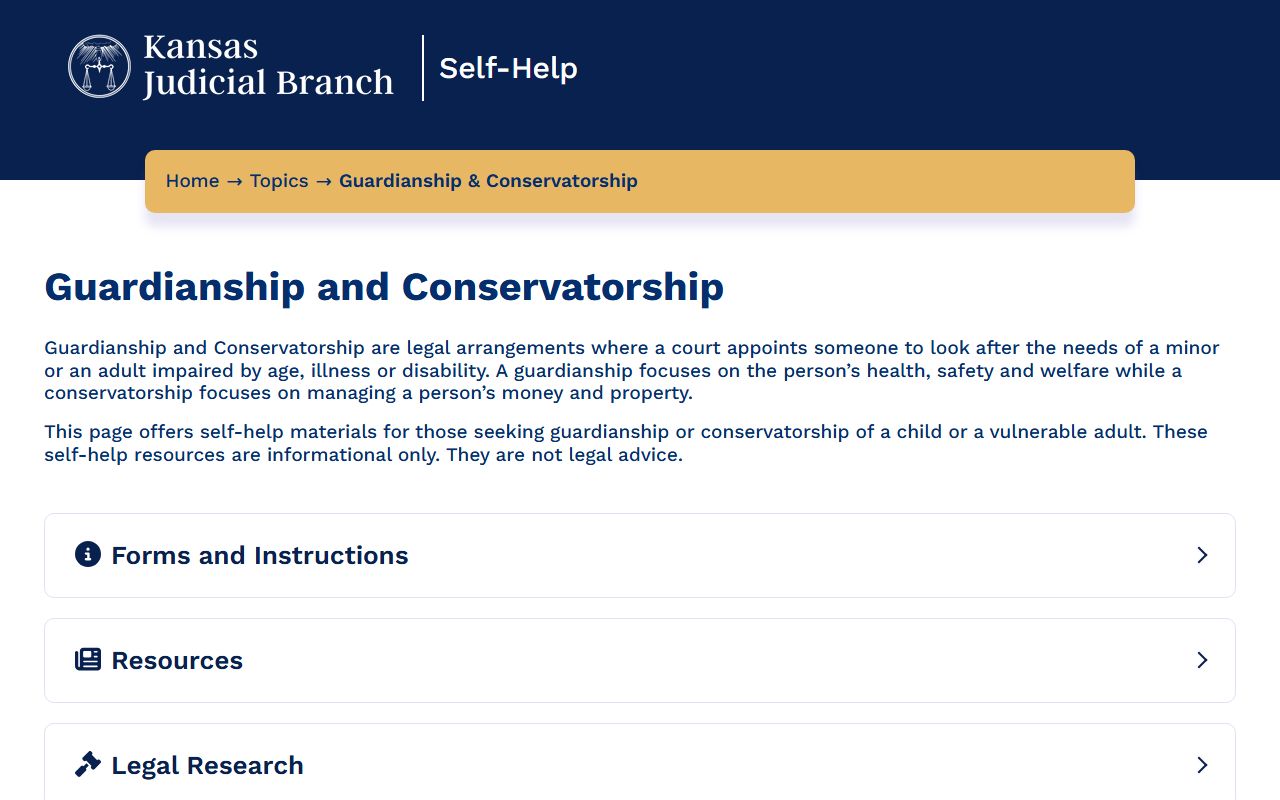
Those forms and self-help resources are statewide, while case filing and copy requests for Jefferson County still route through the District Court office in Oskaloosa.
Jefferson County Probate Fees
Jefferson County-specific probate filing and copy fees were not located in the official research. The state fee table was identified as the fee source to confirm, and the research snippet listed guardianship of an adult or minor child at $91.50. Because filing fees can vary by case type and copy fees can depend on certification, page count, or clerk policy, probate users should confirm with the Clerk of the District Court before filing or ordering copies.
| Item | Amount | Notes |
|---|---|---|
| Guardianship of adult or minor child | $91.50 | Amount found in Kansas Self-Help fee table snippet during research. |
| Original estate or probate filing | Confirm with clerk | Jefferson County-specific amount was not located. |
| Letters testamentary or administration | Confirm with clerk | May depend on case type and filing status. |
| Certified probate copy | Confirm with clerk | Certification and page costs were not confirmed in local probate sources. |
| Small estate affidavit filing | Confirm with clerk | May not require the same process as a formal probate case. |
Note: A missing local fee table is a reason to call the clerk, not a reason to estimate costs from another Kansas county.
Restricted Probate Records
Probate access is shaped by Kansas public access rules and by the sensitive nature of some probate-related cases. Adoption records are confidential in Kansas district court practice. Care-and-treatment and mental health records are confidential. Guardianship and conservatorship files may contain medical, financial, personal, or protected-person information that is not released in a full public copy. Redactions may also remove Social Security numbers, account numbers, protected addresses, minor identifiers, and sealed documents.
Kansas public access starts with the Kansas Open Records Act, including K.S.A. 45-215, K.S.A. 45-216, and K.S.A. 45-221. Jefferson County also states that district court offices are not county government offices, so court records go to District Court administration rather than the county Freedom of Information Officer. That distinction matters for probate because the file is a court record.
County KORA timing rules are still useful for county agency records, but they do not move a probate court file to the county FOI officer. The local open-records page sends district court records to District Court administration at (785) 863-2461. That phone path is the proper fallback when CaseSearch does not show the probate file, when an older paper file is needed, or when the requester needs to know whether a confidential document can be released at all.
When a probate-related document is restricted, the clerk may be able to provide a public docket entry, a redacted copy, or instructions for seeking a court order. The answer depends on the case type and the document requested.
Public Record Search
Sponsored Results