
Jefferson County Arrest Records and Charges
Arrest records and court charge records answer related but separate questions. The arrest side may show the arresting agency, booking date, booking charge text, warrant number, bond, custody status, or release information if the person appears in a sheriff tool. The court charge side begins when the prosecutor files or declines formal charges. Research for Jefferson County identifies the District Court case file as the place where complaints, charges, bond orders, docket events, pleas, dispositions, sentencing, diversion, and revocation events are tracked after filing.
The Jefferson County jail receives persons arrested and taken into custody for booking and incarceration. Jail data is useful for custody status and booking details, but it does not prove a conviction. The filed charge record is handled through court channels. For jail roster and booking detail, use the inmate page. For the full case file, including hearings and outcome, use Jefferson County criminal court records.
The Kansas Department of Corrections is a statewide custody and supervision source, and it is one of the official manifest sources for this page.

KDOC data is most useful after a person has entered state custody or supervision, while Jefferson County arrest records and charges start locally.
How to Find Jefferson County Arrest Records
The access chain starts with the type of fact needed. Current custody and recent release facts are on the sheriff roster path. Active warrant facts are on the sheriff warrant list. Formal charges, charge amendments, and dispositions are searched through Kansas CaseSearch, courthouse terminals, or the Clerk of the District Court. Jefferson County's Open Records Info page states that District Court records are not county government records, so District Court administration at (785) 863-2461 is the local court-record fallback.
- Check the sheriff custody, warrant, or report path if the question is about arrest, booking, or law-enforcement contact.
- Use Kansas CaseSearch for the filed District Court case when the question is about charges after arrest.
- Search by defendant name or case number and confirm that the court is Jefferson County District Court.
- Read each charge line with the docket, because status can change after the first filing.
- Call the Clerk of the District Court for certified copies, older files, courthouse terminals, or records not visible online.
KASPER is a Kansas Department of Corrections resident and offender search source, not a substitute for the court charge docket. The KASPER search disclaimer notes that status can change and that the data serves a specific corrections purpose.
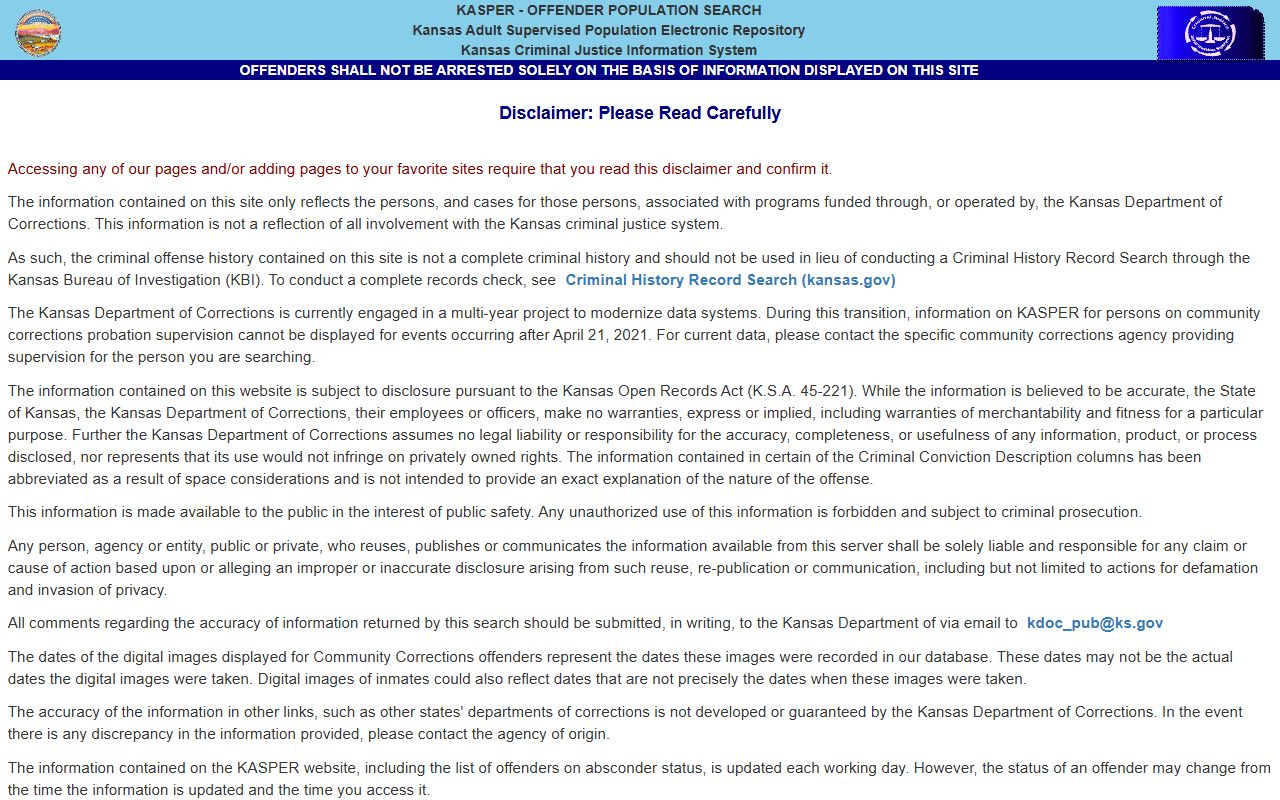
Use KASPER for corrections status, then verify charges after arrest through the Jefferson County court case file.
Charges After Arrest in Jefferson County
The County Attorney decides whether to file formal charges for crimes committed within Jefferson County. Research identifies Joshua Ney as Jefferson County Attorney and lists the office at 300 Jefferson St., Suite 200, P.O. Box 351, Oskaloosa, KS 66066, phone (785) 863-2251. The office prosecutes criminal cases and also handles child-in-need-of-care and care-and-treatment matters, which can involve confidential records.
A charging document is the paper that turns an arrest allegation into a court charge. Kansas practice may use different charging forms depending on the case. The key point for a records user is that the charging document, not the booking label alone, controls what the court is asked to decide.
| Charging Document | Filed By | What It Does |
|---|---|---|
| Complaint | Prosecutor, often based on law-enforcement information | Starts many criminal cases and states the alleged offense. |
| Information | Prosecutor | Sets out formal charges for prosecution when used in the case path. |
| Indictment | Grand jury | Charges an offense after grand-jury action in cases where that path applies. |
Jefferson County Charge Status Table
A charge can change several times after arrest. One arrest may produce several counts, and each count can have its own status. The court file may show whether a charge was added, amended, reduced, dismissed, diverted, or resolved by plea or trial. This is the main reason arrest records should not be read as final outcomes.
| Status | What It Means | Record Clue |
|---|---|---|
| Pending | The charge is filed and not yet finally resolved. | Future hearing, active docket, no final disposition. |
| Amended | The prosecutor or court record changed the original charge text or count. | New charge entry, amended complaint, or docket notation. |
| Reduced | The charge was changed to a lower offense or severity. | Plea or amended charge differs from the first allegation. |
| Dismissed | The court or prosecutor ended that charge without conviction. | Disposition says dismissed or similar wording. |
| Diversion | The case may be dismissed if required terms are completed. | Diversion agreement and later completion or failure entry. |
| Convicted | Guilt was established by plea or trial. | Disposition and sentencing entries appear. |
Jefferson County Charges vs Convictions
Being listed in arrest records or charged in court is not the same as being convicted. A jail roster or warrant list may show the reason a person was booked or sought by law enforcement. The District Court case later shows whether the prosecutor filed the same charge, changed it, dismissed it, or obtained a plea or verdict. Charge status should always be read with the docket and disposition.
| Point | Charge | Conviction |
|---|---|---|
| Legal meaning | An accusation or count filed after arrest. | A final finding of guilt by plea or trial. |
| Timing | Early or mid-case. | At disposition and sentencing. |
| Can change | May be amended, reduced, dropped, or dismissed. | May be affected by appeal, probation, or expungement. |
| Best source | Charging document and current docket. | Disposition and sentencing order. |
Charge Codes and Severity Levels
Charge wording in Jefferson County court records may reference a Kansas statute, a severity level, misdemeanor or felony class, or a short description. Research found sheriff warrant examples tied to criminal and traffic-style case identifiers such as CR and TR. Those identifiers help route the user to the right file, but they do not explain the outcome by themselves. A user should compare the charge text with the final disposition and sentence before drawing conclusions.
The KDOC locating a resident source is relevant when a case has moved beyond local custody into state placement or supervision.

A KDOC location result can follow a conviction or custody transfer, but it does not replace the filed charge history in District Court.
Statewide Arrest and Charge Lookups
Statewide systems help when a person has moved out of the local case stage. KDOC and KASPER may show correctional status. The Kansas Bureau of Investigation can be relevant for criminal-history and registered-offender records. These systems do not always show every local filing, and they may not show dismissed charges or sealed records. Local charges after arrest should still be verified through the District Court file when the case was filed in Jefferson County.
Kansas expungement law is central when a person is trying to understand why an arrest, diversion, or conviction no longer appears in ordinary public results. The official K.S.A. 21-6614 expungement statute is a manifest source for this page.
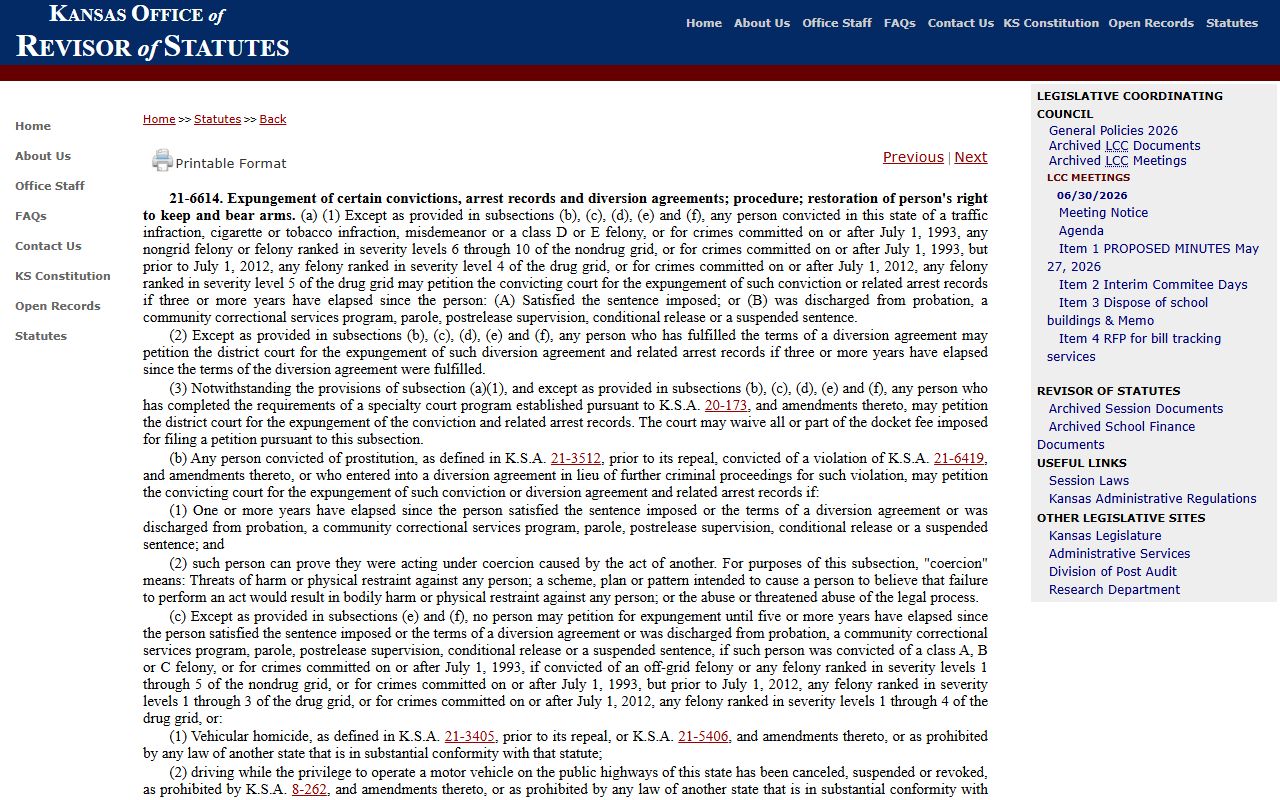
Expungement can restrict public access to arrest records, diversion agreements, or convictions when the statute and court order allow it.
Restricted Jefferson County Arrest Records
Some arrest and court charge records are not open to the public. Juvenile intake and offender information are restricted by Kansas statutes. Child-in-need-of-care and care-and-treatment cases handled by the County Attorney can be confidential. Sealed warrants may be hidden before execution. Expunged arrest records, diversions, and convictions may be restricted even though certain agencies can still access or require disclosure in allowed settings.
The official juvenile intake statute, K.S.A. 38-2310, and juvenile offender confidentiality statute, K.S.A. 38-2326, are both relevant to limits on public arrest and charge records.
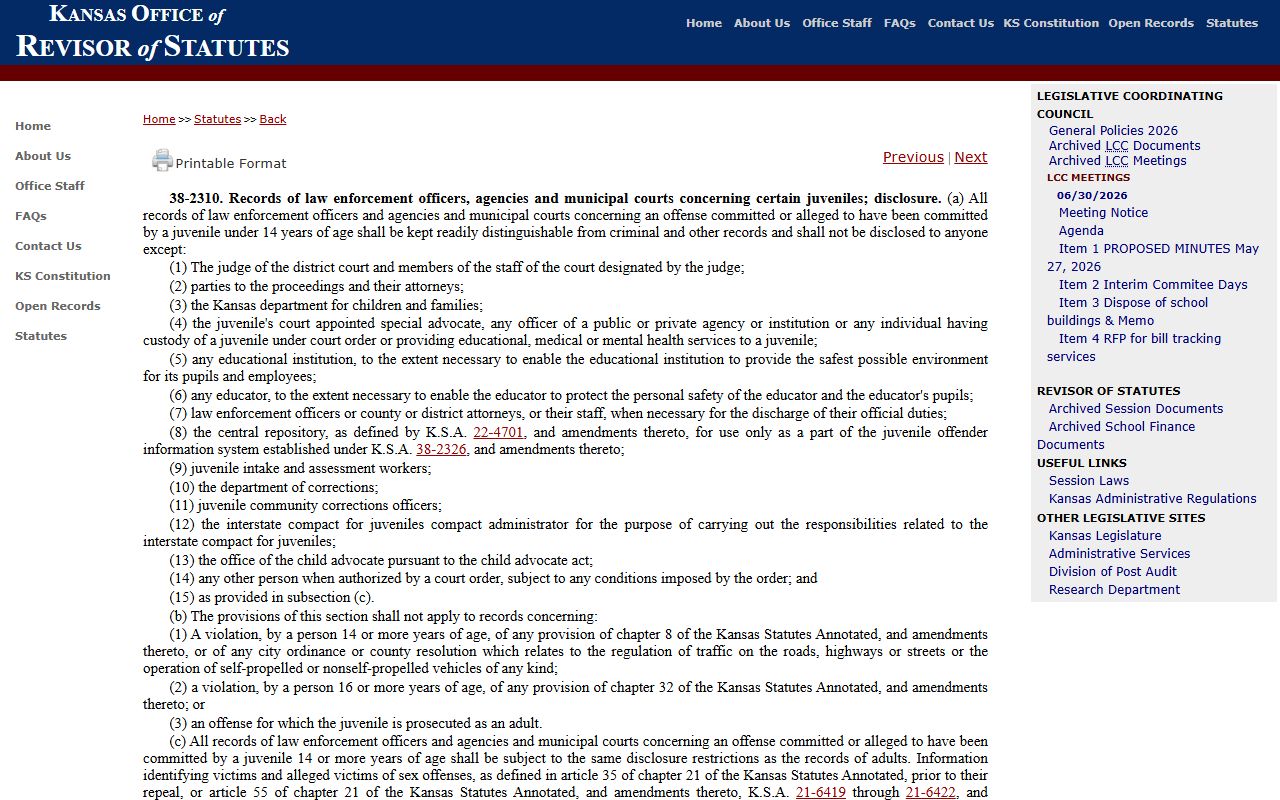
Juvenile intake limits explain why some arrest-related details do not appear in public court or sheriff searches.
The juvenile offender confidentiality statute is also part of the official source set for this page.
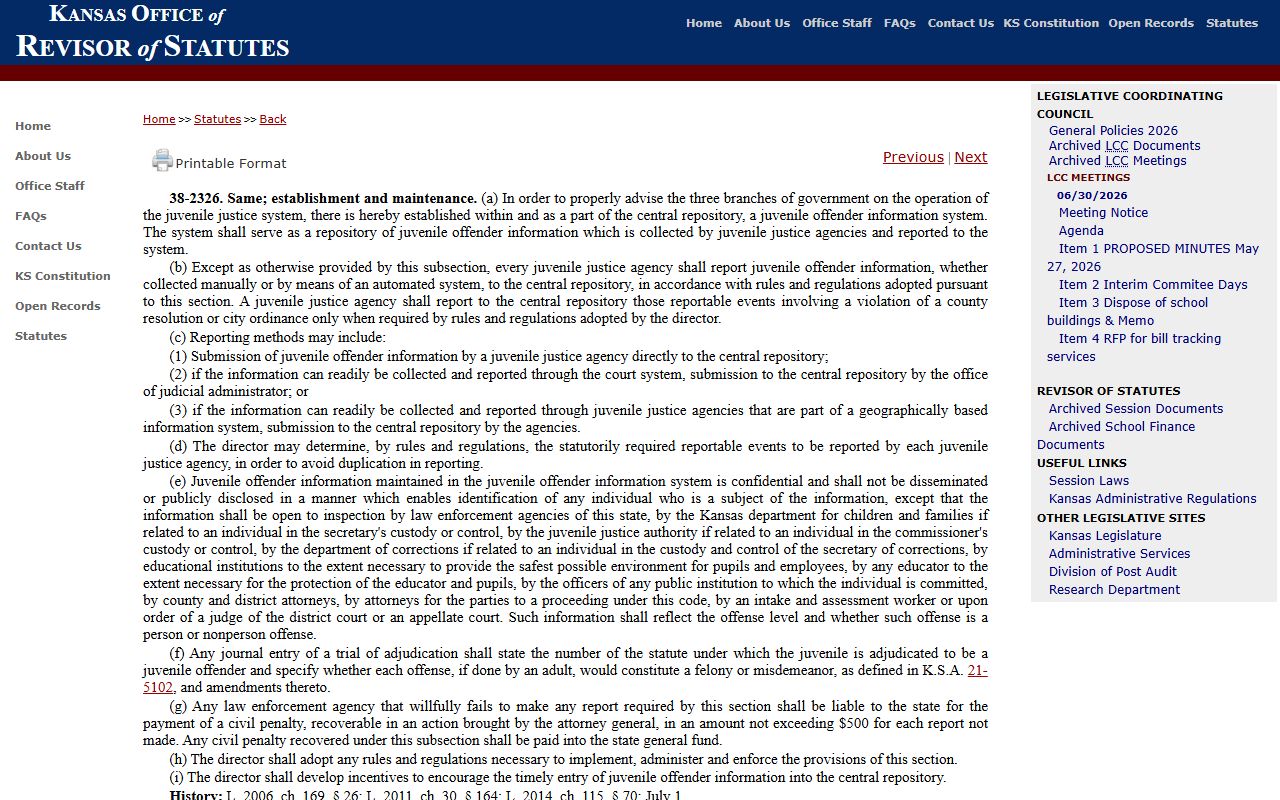
When a juvenile or sealed matter is involved, the absence of a public result does not prove that no record exists.
Sealed vs Expunged Arrest Records
A sealed record is blocked from ordinary public view by law or court order. An expunged record is restricted through the statutory expungement process. In Jefferson County, an expungement request is generally filed in the court where the criminal case, arrest record, or diversion agreement is recorded. The person seeking relief should identify the case number, charge, disposition, sentence or diversion completion, and waiting period before filing.
| Point | Sealed | Expunged |
|---|---|---|
| Public view | Hidden or redacted from ordinary public copies. | Public access is limited after the court grants relief. |
| Typical reason | Juvenile, warrant, protected data, or confidential case type. | Eligible arrest, diversion, or conviction under K.S.A. 21-6614. |
| Access remains | Courts and authorized users may still see sealed material. | Some agencies may retain access under Kansas law. |
| Where to ask | District Court or the issuing court. | District Court where the record was filed. |
Note: A missing public result may reflect sealing, expungement, juvenile confidentiality, data lag, or a case filed in another court.
Background Check Considerations
Arrest records and court charge records should be used with care. A law-enforcement booking entry may not match the formal charge. A filed charge may not match the final disposition. A statewide correctional source may not show dismissed counts. For employment, tenant screening, insurance, credit, or other regulated purposes, use a legally compliant consumer-reporting process rather than informal public lookups.
Important: Do not treat an arrest, jail entry, or pending charge as proof of conviction.
Public Record Search
Sponsored Results